
Castelnaudary cassoulet: what sets it apart and where to eat it
Castelnaudary is 18 minutes from the loft. People come for the cassoulet, which has its own brotherhood, reference recipe and producers, and for the Grand Bassin on the Canal du Midi. Here is what is documented, what is legend, and where to sit down.
A story, not a proven origin
The tale goes that cassoulet was born during the Hundred Years' War, when the people of besieged Castelnaudary pooled their food. The Grande Confrérie du Cassoulet says so itself: it is a legend, no archive mentions it, and it was first written down in the early 16th century. The tourist office states that the dish's origin is not clearly established.
What is dated, according to the Confrérie: a mutton, pork and broad bean stew in Taillevent's 14th-century Viandier; a pottery workshop set up in Issel in 1377, where the cassoles still come from; the first cassoulet factory opened in Castelnaudary by the Bouissou family in 1836; a recipe fixed in 1909.
The Castelnaudary recipe
The recipe published by the Confrérie needs few ingredients: lingot beans from the Lauragais, confit duck or goose legs, pure pork sausage of the Toulouse type, pork from the shank, shoulder or belly, pork rind, a little salt pork, and a stock made from a poultry carcass or pork bones with onions and carrots. It bakes for two to three hours at 150 to 160 °C in the cassole, the deep earthenware dish that gave the dish its name.
The cassole comes from Issel, 8 km north of Castelnaudary, because the town's own clay was unsuitable. Glazed inside, it holds the heat for a slow bake. The word is said to come from the Occitan cassolo.
Castelnaudary, Carcassonne, Toulouse: three versions
The Confrérie and the Castelnaudary tourist office only say that Carcassonne and Toulouse have their own variants. The Aude tourism agency describes them: in Castelnaudary, lingot beans, pork and poultry; in Carcassonne, the same base with a piece of red-legged partridge; in Toulouse, a fuller version with lamb or mutton, rind sausage, duck confit and Toulouse sausages laid on top before baking.
The same source credits the Carcassonne chef Prosper Montagné, in 1929, with the image of a trinity: Castelnaudary the Father, Carcassonne the Son, Toulouse the Holy Spirit. Restaurant recipes vary; the three portraits are a tradition, not a rulebook.
The Grande Confrérie du Cassoulet
Founded on 17 January 1970 by Jean Estève, with André Matet, the brotherhood exists to uphold the prestige of cassoulet and to spread and defend its reputation. It gathers knights, peers and dignitaries, holds a Grand Chapter in spring and helps organise the Fête du Cassoulet every summer, at the end of August in the town centre. Its seat is at 1 avenue Maréchal-de-Lattre-de-Tassigny.
Where to eat cassoulet in Castelnaudary and Revel
We do not rank these places and we are partners of none. They appear on the Castelnaudary tourist office's list of 29 cassoulet restaurants or on a regional tourist board listing, checked on 29/10/2026. Call before you go: hours change with the seasons.
To take home: producers and workshops
Several Castelnaudary firms sell cassoulet in tins or as a fresh cassole. Two could be checked on their own website or official listing on 29/10/2026; the full list is on the tourist office website.
The Grand Bassin and the Cugarel windmill
The Grand Bassin covers nearly 7 hectares, the size of the walled Cité of Carcassonne. Dug in the 17th century, it was the official launch point of the waterway: Castelnaudary was to become the canal's main port after a change of route paid for by the town and the diocese of Toulouse. The Cybèle island in the middle was built as a breakwater, since the basin is exposed to the wind; a guinguette stood there until the 1940s. The basin lies between the port and the four Saint-Roch locks, dated 1678: the canal's only four-chamber lock, rising close to 10 metres.
The port, in the Petit Bassin, holds 51 boats and has flown the Blue Flag since 2009; the Monday market is held on the quay.
On the hill above, on place du Cugarel, the Cugarel windmill is the last of the 32 mills the town had in the 17th century. Restored in 1962, it keeps its whole inner mechanism and looks out over the Montagne Noire. Visits are by reservation through the tourist office, all year, unaccompanied in July and August.
Frequently asked questions
What is the difference between Castelnaudary, Carcassonne and Toulouse cassoulet?
According to the Aude tourism agency, Castelnaudary combines lingot beans, pork and confit poultry; Carcassonne adds a piece of red-legged partridge; Toulouse adds lamb or mutton and Toulouse sausages. Recipes vary from one restaurant to the next.
Was cassoulet invented during the siege of Castelnaudary?
That is a legend, and the cassoulet brotherhood says so itself: no archive mentions it before the early 16th century. A pork and bean stew is recorded in the 14th century.
Where can I eat cassoulet in Castelnaudary?
The tourist office publishes a list of 29 addresses. In town, they include La Table de l'Hôtel de France on avenue Frédéric-Mistral and Maison du Cassoulet on cours de la République. Castelnaudary is 18 minutes from the loft.
When is the Fête du Cassoulet?
Late August, in the centre of Castelnaudary. The 2026 edition, the 25th, ran from 19 to 23 August according to the regional tourist board; check the next dates with the tourist office.
Can I visit a cassoulet producer?
Maison Escudier, on avenue des Pyrénées, opens its workshops by reservation, with a tasting. La Belle Chaurienne has a factory shop on rue Paul-Sabatier, with no workshop visit advertised.
Sleep next door
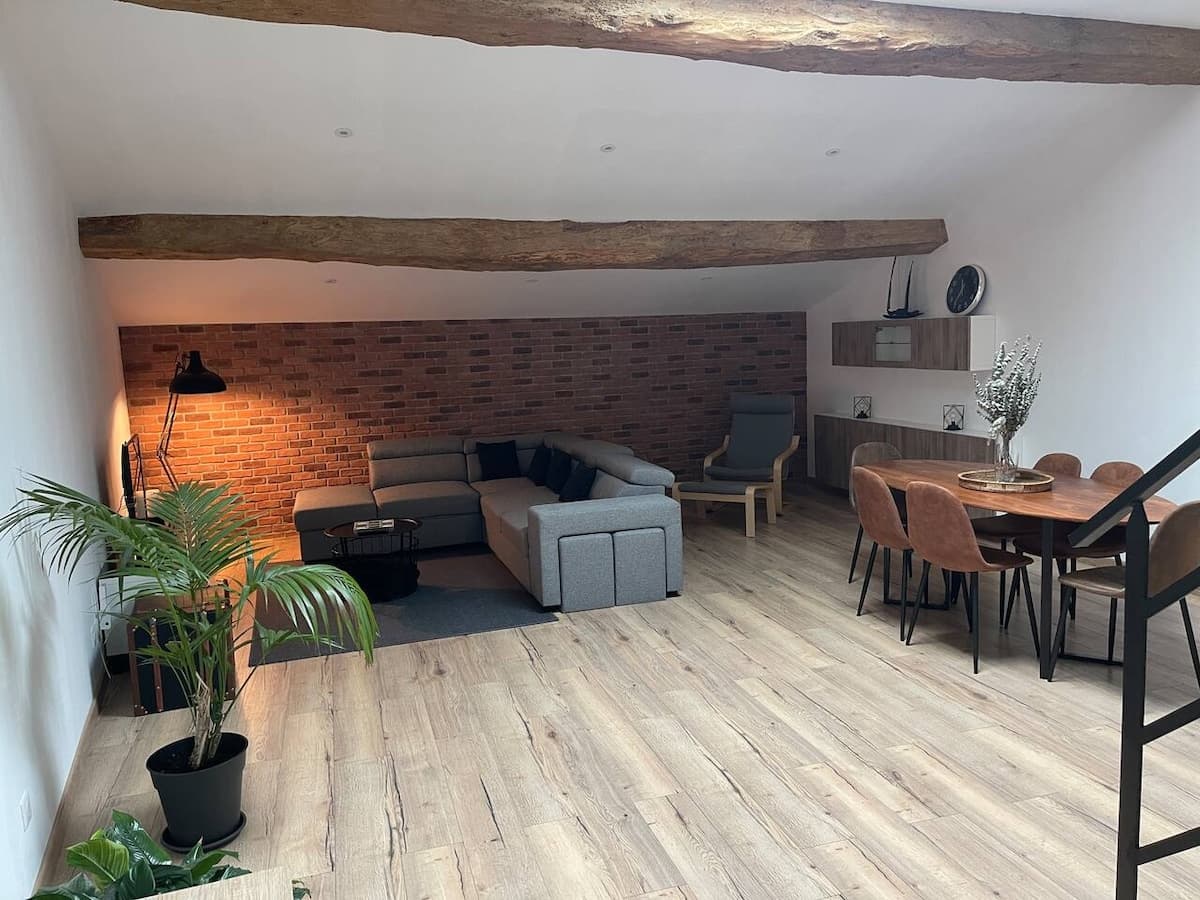
The Industrial Lodge, an 85 m² loft for five in the hamlet of Dreuilhe. Booked direct, 10% less than on the platforms.
€63a nightwhen booking here€70 on the platforms
See also
Your host: Florian