
The Saint-Ferréol waterfall: the fountain, Riquet's dam and Le Réservoir
Below the dam of Lake Saint-Ferréol, a 19th-century park steps down in waterfalls to a fountain inaugurated in 1855. The dam that feeds it is the one Pierre-Paul Riquet began in 1667 for the Canal du Midi, and the canal museum, Le Réservoir, stands next to it. The park is 10 minutes from the loft.
The fountain and the waterfalls
The fountain, which locals call la gerbe, was inaugurated in 1855. Its height depends on the water pressure from the lake: about 25 metres according to Le Réservoir, the museum's official website, over 23 metres according to the Haute-Garonne tourist board. It stands in the park laid out below the engineer's house, which Revel town hall calls the parc de la gerbe d'eau.
The park was designed in the 19th century in the manner of mountain scenery: built waterfalls, rocks, viewpoints and steep paths meant to show off Vauban's wall and the channels that drain the dam. It is open to the public all year, free, from the museum.
How the fountain works, and when it runs
The French heritage inventory (base Mérimée) explains the mechanism. Three channels leave the dam: drain, discharge and overflow. In 1836 the Badorque spillway was replaced by a low valve twelve metres further down, and that valve is what feeds the fountain in the park. The waterfalls are formed by the discharge channel from that valve and by the overflow channel from the surface spillway rebuilt in 1816; the overflow is usually dry, since the lake generally sits below the spillway. All this water then joins the Rigole de la Plaine.
To be plain: no official source publishes days or times when the fountain is switched on, not Le Réservoir, not Revel town hall, not the tourist office. We cannot tell you whether it will be running on the day of your visit. The only way to know is to call the tourist office before you set off.
Riquet's dam: 1667, Vauban, 1694
The first stone was laid on 18 April 1667 by the Archbishop of Toulouse, with Pierre-Paul Riquet present. On the advice of the Chevalier de Clerville, Riquet chose one large reservoir rather than several small ones. Le Réservoir dates the completion of dam and channels to 1672; the Mérimée inventory puts the first phase of the great wall at 1675. Riquet died in 1680, the year of provisional completion, and the canal was filled in May 1681.
In December 1685 Vauban inspected the canal and found it in poor condition. The works he prescribed ran from 1686 to 1694: the Cammazes cutting, which brings Montagne Noire water to the reservoir, and the enlargement of the dam, entrusted in 1687 to Dominique Gillade. According to the French dams committee (CFBR), the great wall was raised by 4.9 metres. The reservoir was finally filled in 1694.
Inside the dam, three bronze taps regulate the flow to the canal. The ones you visit date from 1829 and were in use until 1994: a quarter turn opens a tap and releases 600 litres per second. The dam has been a listed historic monument since 13 March 1997; it belongs to the State and is run by Voies navigables de France.
Why a dam here: water for the Canal du Midi
The Canal du Midi crosses its highest point at the Naurouze watershed, 190 metres above sea level, and that is where it had to be filled. In November 1662 Riquet proposed to Colbert to collect water from the Montagne Noire; a trial channel was dug in 1665 and the royal edict followed in October 1666. Saint-Ferréol is the main reservoir of that system; the Lampy, in 1782, is the second. Water runs from the lake down to Naurouze along the Rigole de la Plaine, which passes through Revel.
The canal, 360 navigable kilometres and 328 structures according to the regional heritage office, has been a UNESCO World Heritage site since 1996 together with its feeder system, under criteria (i), (ii), (iv) and (vi). Le Réservoir recalls that the World Heritage Committee then called the dam one of the most extraordinary feats of modern civil engineering; 2026 is the listing's thirtieth year.
Le Réservoir: the Canal du Midi museum and gardens
Housed in the former engineer's house at the foot of the dam, Le Réservoir tells the story of the canal, its builders, the people who run it today and its water supply. Revel town hall describes an 800 m² exhibition with scale models, audiovisual displays and archive documents. The Galerie des Robinets, some sixty metres into the dam to the three bronze taps, is visited in small guided groups: about thirty minutes, twenty people per slot, online booking required; it is not accessible with a pushchair or wheelchair.
According to lereservoir-canaldumidi.fr, checked 29/10/2026: open in June, September and October from Wednesday to Sunday, 2 pm to 6 pm, and in July and August every day, 10.30 am to 1 pm and 2 pm to 6.30 pm. 2026 prices: museum 6 € (3 € reduced), Galerie des Robinets 5 € (3 €), DUO ticket for both 9 €, free under 8. From 1 October, gallery visits are less frequent: check that a slot is scheduled before booking.
Getting there and parking
The park and museum are at 1 avenue Paul Riquet, Saint-Ferréol, in the commune of Revel: 10 minutes and 6 kilometres from the loft. There is a car park in front, with a disabled space about fifty metres from the entrance; no fee is published. By liO bus, lines 356 and 357 from Toulouse, 761 and 767 from Castres and 414 from Castelnaudary serve Saint-Ferréol and a Musée stop; out of season the terminus is Revel. In 2025 a summer shuttle at 1 € return linked Revel to the lake from 5 July to 31 August; as of 29/10/2026 no 2026 run had been announced.
By bike, the climb from Revel to the dam is about 200 metres over 4 kilometres; there are bike racks at the museum entrance, and a lock can be borrowed at the desk.
Frequently asked questions
Does the Saint-Ferréol waterfall run all year?
Nobody publishes that. The waterfalls depend on the discharge and overflow channels, and the Mérimée inventory notes the overflow is usually dry; the fountain depends on the lake's pressure. Call the tourist office (+33 5 34 66 67 68) before coming for it.
How high is the Saint-Ferréol fountain?
About 25 metres according to Le Réservoir, over 23 metres according to the Haute-Garonne tourist board, depending on the lake's water pressure. It was inaugurated in 1855.
Who built the Saint-Ferréol dam, and when?
Pierre-Paul Riquet, to feed the Canal du Midi. First stone on 18 April 1667, first phase completed in 1675, raised by 4.9 metres under Vauban in 1686 and 1687, finally filled in 1694.
Can you go inside the dam?
Yes, through Le Réservoir's Galerie des Robinets: a guided visit of about thirty minutes, twenty people per slot, online booking required. Slots become scarcer after 1 October.
Is there a fee for the waterfall park?
No. The park is open to the public all year without a ticket. The museum and the Galerie des Robinets are paid.
Sleep next door
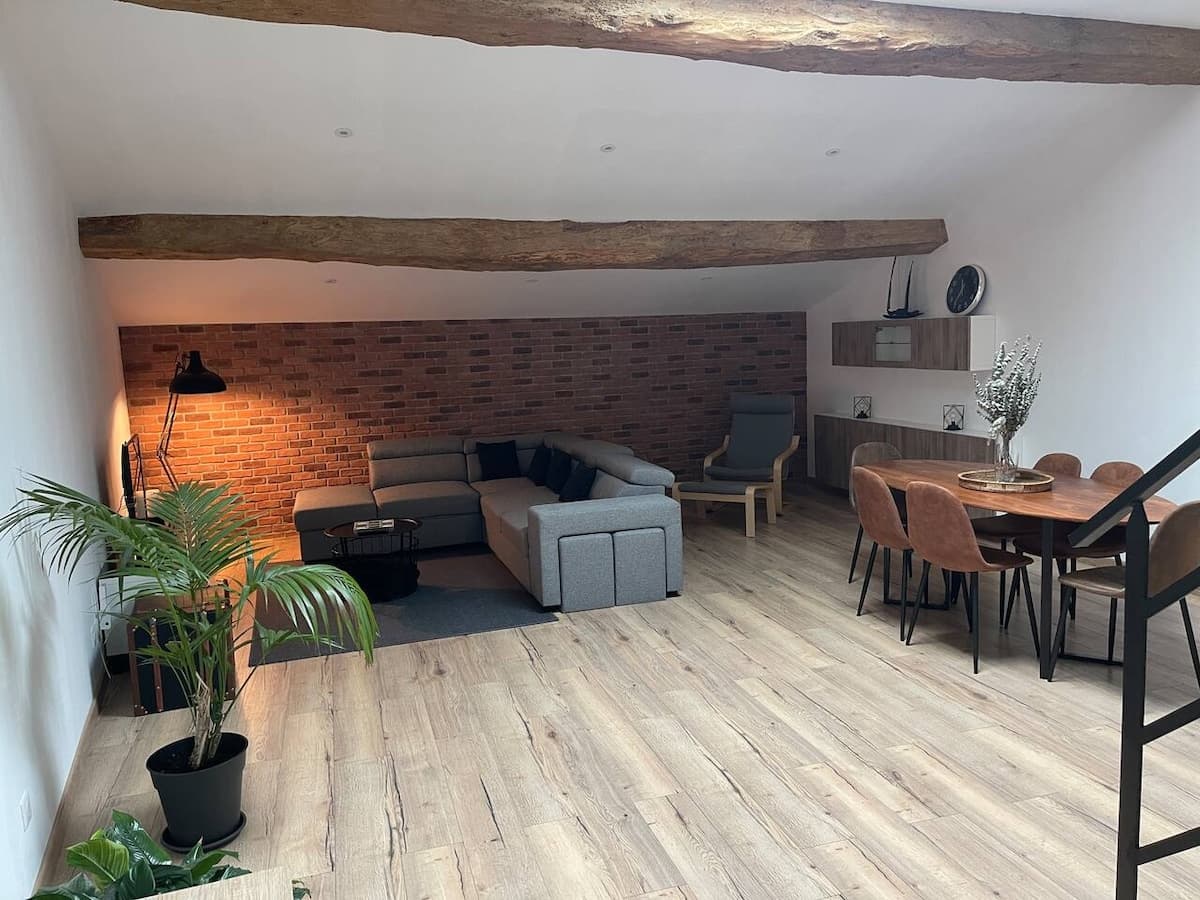
The Industrial Lodge, an 85 m² loft for five in the hamlet of Dreuilhe. Booked direct, 10% less than on the platforms.
€63a nightwhen booking here€70 on the platforms
See also
Your host: Florian