
Pierre-Paul Riquet: the man behind the Canal du Midi, from Béziers to Revel
Pierre-Paul Riquet was not an engineer: he collected the salt tax in Languedoc. Yet he persuaded Colbert and Louis XIV to dig a canal from Toulouse to the Mediterranean, and found the water to fill it in the Montagne Noire above Revel, where he settled in 1648. He died in 1680, a year before the canal opened. Here is what official sources say about him, and where to find his traces within an hour of the loft.
Who Pierre-Paul Riquet was
He was born in Béziers into a merchant family. Official sources disagree on the year: the DRAC Occitanie (the regional heritage office) says he was 50 in 1654 and the Occitanie tourist board gives 1604, while the town of Bonrepos-Riquet, which owns his château, writes that he was "probably born in 1609". We leave the question open.
His trade was tax farmer of the gabelle, the royal salt tax, collected on the trade, transport and storage of salt. The tourist board describes him as a tax collector on the lands of Languedoc and notes that he was no engineer. He was ennobled in 1666, the year of the canal's edict. He died in Toulouse in 1680, before the works were finished, and is buried in the cathedral of Saint-Étienne.
Colbert, the 1666 edict and the money
According to the DRAC, Riquet began working on the project in 1654. From 1655 to 1662 he experimented at home, in the park of his château at Bonrepos, with test basins fed by rainwater: seven years learning a technique he had never studied. In 1662 he secured the support of Jean-Baptiste Colbert, Louis XIV's finance minister, and sent him his plans. Every earlier canal scheme had failed on the high point at Naurouze, which has to be supplied with water; Riquet proposed bringing it down from the Montagne Noire.
In October 1666 Louis XIV signed the edict ordering the Canal royal du Languedoc, the canal's original name, and Riquet was appointed contractor. He sank his own fortune into it and paid the workers when royal funds ran short. The DRAC puts the final cost at 15 million livres, 70% over the estimates. Up to 12,000 workers were on site at once: with Versailles, the largest building project of the reign.
Timeline of the Canal royal du Languedoc
1662
Riquet presents Colbert with his plan to feed the canal from the Montagne Noire.
1665
A trial channel proves the water can reach Naurouze.
October 1666
Royal edict ordering the canal.
January 1667
Two thousand workers are hired. Work starts at Toulouse, between Toulouse and Naurouze, and in the Montagne Noire.
1672
The first section, Toulouse to Naurouze, is finished and filled.
1674
Boats sail from Toulouse to Castelnaudary.
1680
Riquet dies in Toulouse. His son Mathias takes over.
1681
Twenty-five barges leave Toulouse for Sète on the inaugural voyage, fourteen years after work began.
1682 to 1684
Completion, depending on the source: end of 1682 for the Mérimée heritage database, 1684 for the Occitanie tourist board.
1686 to 1694
Vauban's inspection, then aqueducts, the Cammazes tunnel and the raising of the Saint-Ferréol dam. The DRAC dates the canal's final elements to 1694.
What he saw, and what he did not
Riquet saw his dam rise at Saint-Ferréol, water reach Naurouze in 1672 and the first boats sail to Castelnaudary in 1674. He did not see the inaugural voyage of 1681, nor the works Vauban prescribed in 1686, nor his dam raised by nearly five metres. The canal as it is today is Riquet's design completed by a generation of engineers after him.
His traces around Revel
Riquet settled in Revel in 1648, and from there planned the channels that carry Montagne Noire water to Naurouze, helped by Pierre Campmas, the town's water engineer. Revel town hall records this; no official source locates his house in the bastide, so we do not point to one.
Bonrepos-Riquet: his château and test basins
North-east of Toulouse, the château of Bonrepos is the estate Riquet bought in 1651 according to the Mérimée database (1652 according to the town and the tourist board) and rebuilt from 1654 to 1666 by Isaac Roux, a mason from Revel. In the park he used the springs and slope of the valley to test the techniques later used on the canal: the test basins, about two hectares in a 29-hectare park. The château, moats, orangery, gardens and Riquet's waterworks have been a listed historic monument since 31 July 2008, owned by the town, and the estate carries the Maison des Illustres label.
Visits are guided and dated. According to bonrepos-riquet.fr, checked 29/10/2026, for 2026: 5 April to 28 June, Sundays at 3 pm (1 h 45); July and August, Tuesdays at 10 am and 3 pm, Wednesday to Sunday at 10 am (classic tour), 2:30 pm (park and basins) and 4 pm (château and gardens); 6 September to 25 October, Sundays at 3 pm. Two evening tours on Wednesdays 15 July and 19 August at 8:30 pm. 2026 prices: 10 €, 5 € reduced, free under 12; no booking for individuals, by email for groups of 15 or more. Free parking by the château and the town hall.
Toulouse: his tomb and the canal archives
Riquet lies in a crypt of Saint-Étienne cathedral, place Saint-Étienne, Toulouse. According to the Toulouse tourist office, checked 29/10/2026, the cathedral is open Monday to Saturday 8 am to 7 pm and Sunday 9 am to 7 pm. The canal archives, "700 linear metres of files" according to Voies navigables de France, are kept by VNF at the port Saint-Étienne nearby; consultation terms are not published. In Béziers, his birthplace, a statue by David d'Angers (1838) stands on the allées Paul-Riquet, but that is more than an hour and a half away.
Frequently asked questions
Who was Pierre-Paul Riquet?
A salt-tax farmer from Béziers who designed and partly financed the Canal du Midi under Louis XIV. He was not a trained engineer; he died in 1680, before the canal opened in 1681.
When was Pierre-Paul Riquet born?
Official sources differ: 1604 according to the DRAC and the Occitanie tourist board, "probably 1609" according to the town of Bonrepos-Riquet. He was born in Béziers.
Did Riquet see the Canal du Midi finished?
No. He saw boats reach Castelnaudary in 1674, but he died in 1680; the inaugural voyage from Toulouse to Sète took place in 1681 and Vauban's works ran until 1694.
Can you visit Riquet's house?
Yes, his château at Bonrepos-Riquet, 53 minutes from the loft, opens for guided tours from April to October, test basins included. In Revel, no official source names a house you can visit.
Where is Pierre-Paul Riquet buried?
In Saint-Étienne cathedral in Toulouse, open daily according to the Toulouse tourist office.
Sleep next door
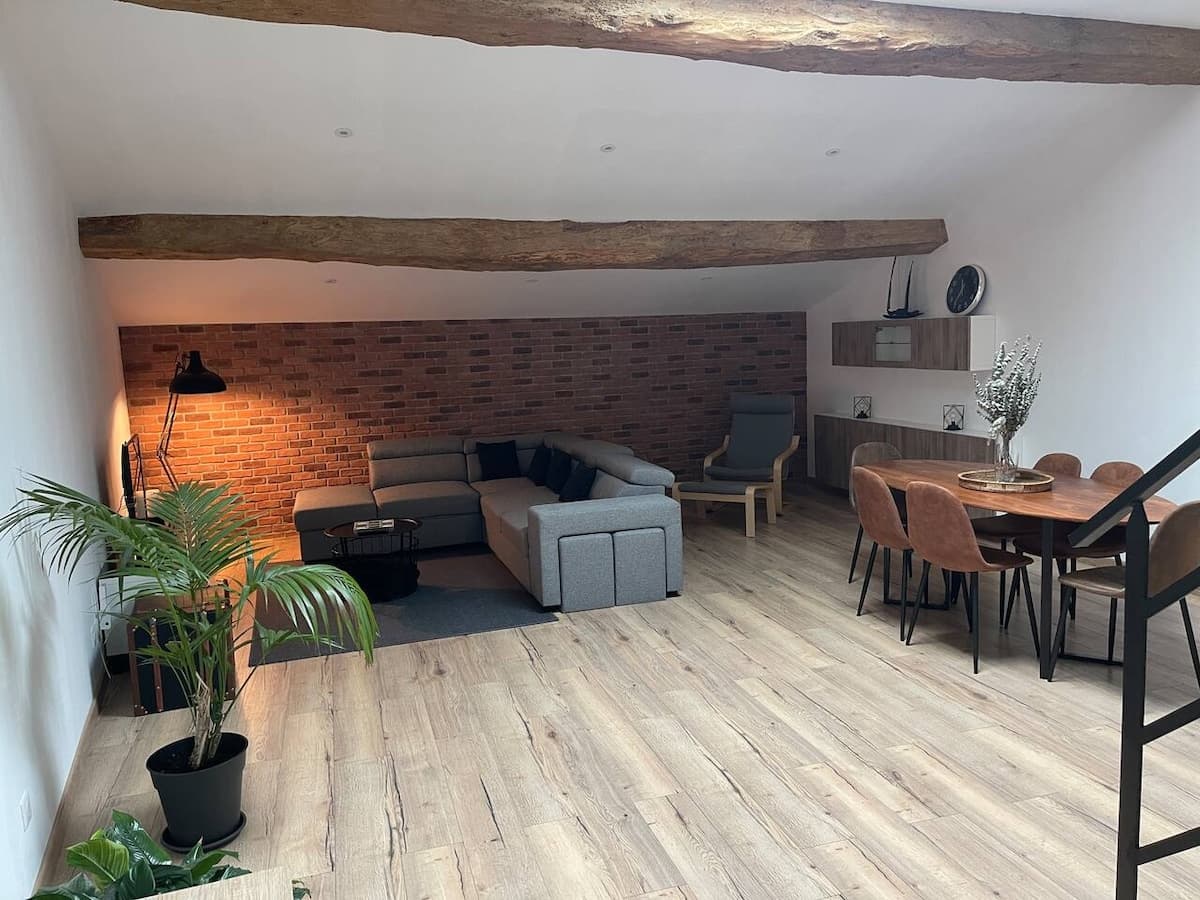
The Industrial Lodge, an 85 m² loft for five in the hamlet of Dreuilhe. Booked direct, 10% less than on the platforms.
€63a nightwhen booking here€70 on the platforms
See also
Your host: Florian