
Cathar castles from Revel: Saissac, Lastours and further afield
From the loft, two so-called Cathar castles are under an hour's drive: Saissac, 32 minutes away, and the four castles of Lastours, 63 minutes, not counting Carcassonne at 52. Montségur, Minerve and Quéribus are further, between an hour and a half and over two hours. This page gives, source by source, the history of each site, its 2026 hours and prices as published, and what “Pays Cathare” and “Cathar castle” actually mean.
“Pays Cathare”, “Cathar castles”: what the words mean
Pays Cathare is first of all a trademark. The Aude département created it in April 1991 and registered it with the INPI; according to the Aude tourism agency it now covers 500 professionals, mostly food producers, wine cellars and shops working to forty sets of specifications. Alongside the trademark, the département runs a network of 22 “Sites du Pays Cathare”: castles, abbeys, medieval towns and museums. Saissac presents itself as a Pays Cathare castle, and Lastours is one of the Aude's royal fortresses.
“Cathar castle” is a tourism phrase, not a historical category. The ruins you visit are mostly fortresses built or rebuilt by the king of France after the crusade, not by the Cathars. That is the argument of the UNESCO nomination, which the French Ministry of Culture describes as an exceptional testimony to the territorial defence system designed and run by the king of France after the Albigensian Crusade. On 26 July 2026 the World Heritage Committee inscribed eight sites under the name “Royal Capetian Fortresses of Languedoc”: the castle and ramparts of Carcassonne, Aguilar, Lastours, Montségur, Peyrepertuse, Puilaurens, Quéribus and Termes. Saissac is not among them.
We keep the phrase “Cathar castles” on this page because it is what people search for, and we say each time what the site really has to do with the Cathars.
The Albigensian Crusade in a few dates
Historians use “Catharism” for a dualist Christian dissidence that spread through the Midi from the mid-12th century and organised itself as a church after a council held in 1176 at Saint-Félix de Caraman, today Saint-Félix-Lauragais, 11 minutes from the loft. What is known of its doctrine comes mostly from Inquisition interrogations and from Catholic treatises written to refute it, as the commune of Cucugnan, which runs Quéribus, itself points out. Accounts of the “perfects” and “good men” deserve that caution.
The chronology, after Larousse and Universalis: in 1208 the papal legate Pierre de Castelnau was murdered and Innocent III called the crusade. In 1209 Béziers and then Carcassonne fell; Simon de Montfort took command. In 1213 the king of Aragon, ally of the southern lords, died at the battle of Muret. In 1226 Louis VIII led the crusade himself. In 1229 the Treaty of Paris, also called Meaux-Paris, attached Languedoc to the Crown. Montségur held out until 1244. The crusade, Larousse writes, disorganised Catharism without uprooting it; the Inquisition finished the task by the first quarter of the 14th century.
Saissac, the nearest: 32 minutes
Saissac castle stands at the southern end of the village on a spur of the Montagne Noire. The commune, which runs it, dates its construction to around 900 by carbon-14 on a fragment of charcoal taken from the keep's masonry; the first written mention is from 960, when the bishop of Toulouse left it to the count of Carcassonne. In the 12th century Bertrand de Saissac, guardian of the young viscount Raimond-Roger Trencavel from 1193 to 1199, is held to have been close to the Cathars, on the evidence of Inquisition sources. During the crusade the lords of Saissac submitted; the lordship passed to Bouchard de Marly in 1209. The Mérimée heritage record notes that the crusade would only have dismantled the original fortress.
What you see dates mostly from the late 13th and the 16th centuries: keep, square towers and curtain walls, then a residential wing remodelled by the Bernuy family, woad merchants, and gun ports added for the Wars of Religion. Sold as national property at the Revolution, the keep was dynamited by treasure hunters. The ruins have been a listed historic monument since 17 February 1926; the commune has owned them since 1994 and consolidated the site from 1996 to 2000.
The treasure was found all the same, in 1979 and during works in the village: 2,000 deniers from the 1270s, almost all bearing the effigy of Saint Louis, the largest royal hoard ever found buried in Languedoc. Two restored rooms of the residence display it, with a twenty-minute film and panels on 13th-century coinage.
2026 hours published by the Aude tourism agency, consulted on 29/10/2026: 1 to 31 October 2026, daily 10 am to 5 pm; 1 November to 13 December 2026, Saturday and Sunday 10 am to 5 pm; 20 to 24 December 2026, Monday to Wednesday 10 am to 5 pm. The commune's undated yearly grid shows a closure in January and weekend and school-holiday openings from February to March and November to December. 2026 prices: 6 € per adult, 3 € per child, 5 € for students.
Lastours, four castles on a ridge: 63 minutes
At Lastours, in the Cabardès, four castles follow one another along a rocky spur above a once-mined valley: Cabaret, Tour Régine, Surdespine and Quertinheux. The site operator tells that in the 12th century the co-lordship of Cabaret comprised three castles under the authority of viscount Trencavel. In 1209 Simon de Montfort tried in vain to take Cabaret; in 1211 Pierre-Roger de Cabaret handed it to Bouchard de Marly after a long resistance. Around 1240 to 1241 the three castles were rebuilt and a fourth added, the Tour Neuve, later Tour Régine, which the operator presents as a sign of the French monarchy's will to tighten its control. The ruins have been a listed monument since 1905 and are one of the eight royal fortresses inscribed by UNESCO in 2026.
The visit is a walk: a 4 km route, about 2 h 30, with a significant climb that calls for reasonable fitness. The operator requires walking shoes or closed trainers and recommends at least one bottle of water per person. Dogs are allowed; the castle route is not wheelchair accessible. A belvedere across the valley gives two panoramic views of the four castles, five minutes on foot from its car park and accessible to visitors with reduced mobility.
According to the operator's website and Tourisme Occitanie, consulted on 29/10/2026: adults 9 €, ages 16 to 25 6 €, ages 6 to 15 4.50 €, free under 6, family 15 € for one adult and two children, 23 € for two adults and two children; belvedere only 3 € per adult, free for children. Castle hours: 9.30 am to 4.30 pm from February to March and October to December, 9.30 am to 6 pm from April to June, 9 am to 7 pm in July and August; closed on 25 December and in January. The belvedere closes in November. The site may close in a heatwave.
You park in a large free car park at the entrance to Lastours village, then walk ten to fifteen minutes to the reception house at 22 route des 4-Châteaux.
Carcassonne: 52 minutes
The Cité of Carcassonne has been a World Heritage site since 1997, and its castle and ramparts are one of the eight royal fortresses inscribed in 2026. The day in Carcassonne, parking and the drive from Revel have their own page.
Further afield: Montségur, Minerve, Quéribus
These three sites are often named alongside the others, but they do not fit the same half-day. The times below are one-way driving times from the loft, calculated on 29/10/2026.
Combining Saissac, Montolieu and Lastours
Saissac, Montolieu and Lastours lie on the same southern slope of the Montagne Noire, west to east, between the loft and Carcassonne. Montolieu, the book village, is 40 minutes from the loft, between the two castles; its page covers bookshops, museum and restaurants.
Frequently asked questions
Which Cathar castle is nearest to Revel?
Saissac, 32 minutes from the loft: a castle recorded in 960 and altered up to the 16th century, with the hoard of 2,000 Saint Louis deniers on show in two rooms. Lastours is 63 minutes away, Carcassonne 52.
Is Saissac castle open in winter?
Not in January. According to the Aude tourism agency, consulted on 29/10/2026, it opens daily in October 2026 from 10 am to 5 pm, then on Saturdays and Sundays from 1 November to 13 December, and from 20 to 24 December Monday to Wednesday.
How long does it take to visit the castles of Lastours?
About 2 h 30 for the 4 km route linking the four castles, with a significant climb; closed shoes are required and water advised. The belvedere, five minutes from its car park, takes half an hour and costs 3 €.
Why are the Cathar castles said not to be Cathar?
Because the ruins you see were built or rebuilt by the king of France after the crusade, to hold Languedoc and then the border with Aragon. It is under the name “Royal Capetian Fortresses of Languedoc” that eight of them, including Lastours and Carcassonne, were inscribed by UNESCO on 26 July 2026.
Can you do Montségur as a day trip from Revel?
Yes, with 90 minutes' drive each way plus the climb on foot to the castle at 1,207 m. In October 2026 it opens from 10 am to 5 pm, from November to December 11 am to 4 pm; check the season on the Ariège Pyrénées Tourisme website.
Sleep next door
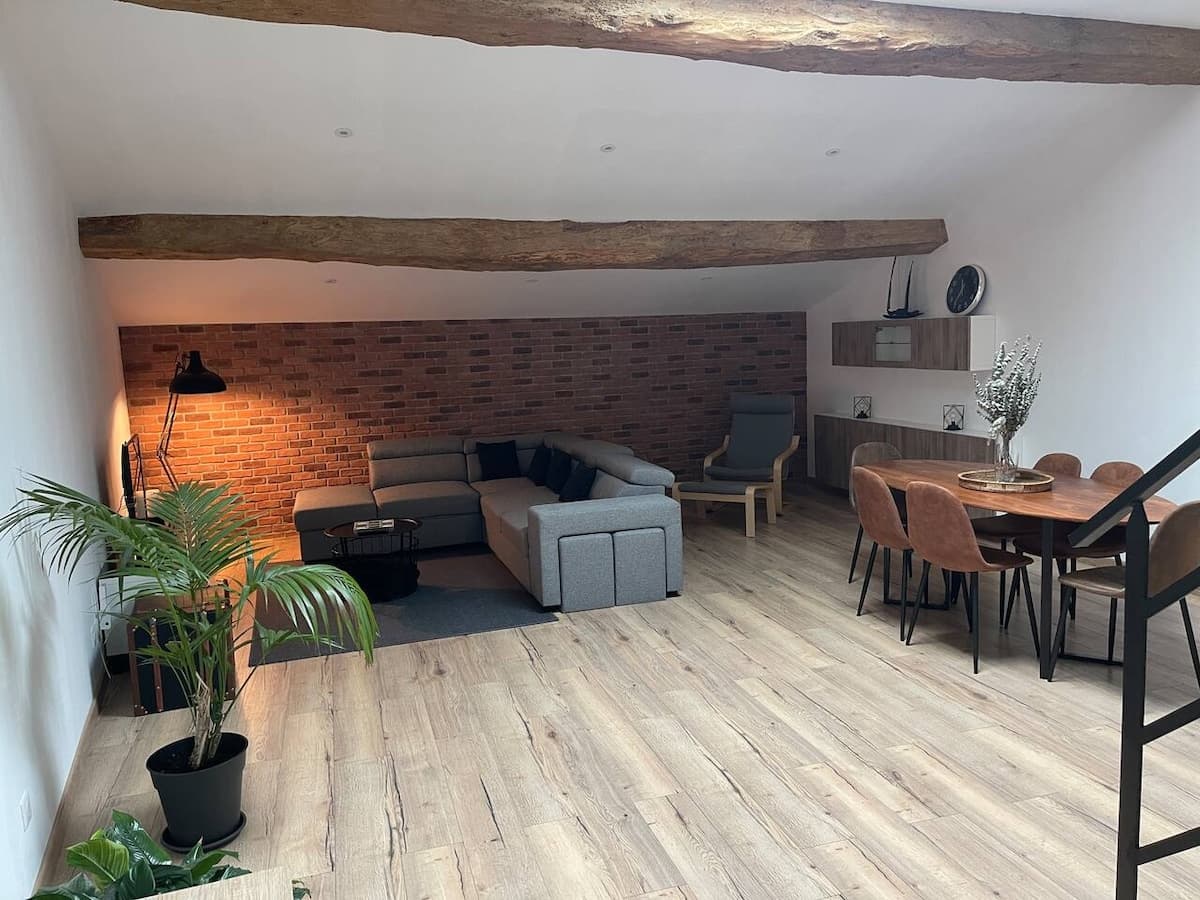
The Industrial Lodge, an 85 m² loft for five in the hamlet of Dreuilhe. Booked direct, 10% less than on the platforms.
€63a nightwhen booking here€70 on the platforms
See also
Your host: Florian