
Castelnaudary: things to see and do, beyond the cassoulet
Castelnaudary is 18 minutes from the loft. The cassoulet has its own page; this one covers the rest: a Gothic collegiate church and its organ, the courthouse Catherine de' Medici founded, now a museum, a baroque chapel, a listed apothecary, the Monday market, boats on the canal, the cinema and the parking rules. Every fact comes from an official source checked on 29/10/2026.
A town of castle, canal and wind
A document of 1118 names the town Castellum Novum Arri; it grew around that castle and served as a stronghold during the crusade against the Cathars. In 1355, during the Hundred Years' War, the Black Prince burned it. In 1366 it received the status of a bastide, which the place de Verdun still reflects. In 1554 Catherine de' Medici, countess of the Lauragais, made it the seat of a sénéchaussée and installed the Présidial, a civil and criminal court that drew lawyers and judges.
The Canal du Midi opened in 1681 and gave the town a port. Castelnaudary lost its sub-prefecture to Carcassonne in 1926. Since 1976 it has hosted the Foreign Legion's 4th regiment, its training regiment. With 300 windy days a year on average, according to the tourist office, the town once had 32 windmills; one remains, the Cugarel mill.
The Saint-Michel collegiate church and its Cavaillé organ
On rue Saint-Michel, the collegiate church is a southern Gothic building of the 13th and 14th centuries. Pope John XXII raised it to collegiate rank and installed a chapter of canons; a large cloister once stood against its south wall, where the courthouse now is. The original timber vault burned in 1355 and was rebuilt in stone; only the first bay of that vault survives. The Mérimée record adds that the church was rebuilt in the late 14th century on the regional pattern, an open-roofed nave and a deep vaulted choir, then reworked after the Wars of Religion and in the 19th century. It has been a listed monument since 18 October 1910.
Inside: a five-sided choir with lancet windows and 19th-century glass, 17th-century stalls, a baroque high altar topped by a ciborium with three angels. The organ was built between 1774 and 1778 by Jean-Pierre Cavaillé and enlarged in 1860 by Aristide Cavaillé-Coll; it has been listed since 1969.
The Présidial and the Musée du Lauragais
Above the Grand Bassin, on the high ground of the old town, the Présidial stands where the founding castle stood. The Mérimée record for the old castle notes that the court moved into its walls in 1554, that the large mullioned windows probably date from then, and that the prisons stayed there until the 19th century; in 1622, during Louis XIII's visit, the magistrates obtained the demolition of the prison wing. The roof and the façade with its four mullioned windows have been listed since 27 April 1948.
The Musée du Lauragais, its exact name, occupies the former prison next to the Présidial, on rampe du Présidial. The town hall says it opens in summer, from July to the end of September, around temporary exhibitions; the Aude tourism agency's listing shows an adult price from 3 €, undated. Daily hours and permanent collections are not published online, so call before walking up.
The Notre-Dame-de-Pitié chapel and the hospital apothecary
On rue de l'Hôpital, the Notre-Dame-de-Pitié chapel was built in the 16th century outside the walls, according to the consular registers, to house a statuette of the Virgin found on a pile of rubble. Seized as national property at the Revolution, it was bought back in 1796 by thirty residents of the Saint-Antoine quarter to save it from demolition; it stayed private and held services until 1972. Its 18th-century decor lines up panelling topped by around ten bas-relief scenes of the Passion, a baroque altarpiece in red Caunes-Minervois marble and a 16th-century gilded wooden Pietà. Panelling and altarpiece have been listed since 1911. It opens only to groups of 12 or more, by appointment through the tourist office.
Nearby, the hospital keeps a former apothecary listed on 19 May 1994, with a collection of pharmacy jars listed as early as 1911. The building is Romanesque in origin; its second nave dates from 1665, its bell tower from 1598, its façade from 1669, and the hospital programme of 1772 is due to the bishop of Saint-Papoul. The tourist office opened it for guided visits on European Heritage Days, on 20 September 2025; no regular visits are announced.
The old town on foot
The tourist office points out the Hôtel Latapie on Grand-Rue, a 17th-century mansion now used as a nursery school, whose carved wooden door is protected; above the lintel, the town's coat of arms, later joined by a woman in a Phrygian cap. On place de Verdun, the market hall once housed the covered markets, the herb market and the weights and measures; it has been remodelled several times. Also worth spotting: the former Carmelite convent, the former Grand Bazar of the town hall, rue du Puits and impasse des Boutiquiers. The former town hall has been listed since 1948 for its staircase and ironwork.
The Monday market
The market runs on Mondays from 8 am to 1 pm, according to the town hall, checked on 29/10/2026; that day, parking is banned on place and cours de la République from 5 am to 4 pm, which tells you where it sets up. The market after the Fête du Cassoulet is not held. The tourist office describes a food market, vegetables, fruit, meat, eggs, cheese, with a few organic producers, plus clothing and crafts; it also lists a food market on Saturday mornings and night markets on Thursday evenings in July and August, from 2 July to 27 August 2026.
On the water: boat trips, hire, bikes
The Grand Bassin and the port are where canal trips start. The operators below are listed on the tourist office website, checked on 29/10/2026; we are not partners with any of them. Prices are those shown on their listings, with no guarantee they are current.
Cinema, theatre, library, pool
The Véo cinema is in the Espace Tufféry at 31 boulevard Lapasset: three air-conditioned screens of 73, 129 and 232 seats, 4K digital and 3D projection, open 365 days a year according to the tourist office listing checked on 29/10/2026, which shows a full price of 9.50 €, 5 € for children and 6.90 € for students, with free parking. The Scène des 3 Ponts theatre on rue du Général-Dejean and the Georges-Canguilhem media library at 8 rue du Commandant-Raynal complete the picture. Castelnaudary's indoor pool, handy on wet days, is on our rainy-day page.
Parking and getting around
The town hall regulates parking in the centre across nine signposted zones: on weekdays except public holidays, from about 9 am to noon and 2 pm to 6.30 pm, parking is limited to two hours, which can be split over the day; nowhere in the commune may a vehicle stay more than 24 hours in one spot. On market and fair days, place and cours de la République are closed to parking from 5 am to 4 pm. The town publishes no list of named car parks, but an interactive map is online. A town-centre shuttle, Darybus, runs four loops on Mondays and Fridays for 1 € a day.
Frequently asked questions
What is there to see in Castelnaudary in half a day?
The Saint-Michel collegiate church and its Cavaillé organ, the Présidial and the Musée du Lauragais in summer, the lanes of the old town, then the Grand Bassin and the Cugarel mill. Castelnaudary is 18 minutes from the loft.
What day is Castelnaudary market?
Monday, 8 am to 1 pm, on place and cours de la République, according to the town hall. The tourist office also lists a Saturday morning food market and Thursday night markets in July and August.
Can you take a boat trip on the Canal du Midi in Castelnaudary?
Yes. The Saint Roch tour boat leaves the quai du Port for one or two hours, from 1 April to 31 October 2026 according to the tourist office; Le Boat hires licence-free boats on the Grand Bassin.
Where can I park in Castelnaudary?
In the centre, in the regulated zones, for two hours at most on weekdays between 9 am and 6.30 pm; place and cours de la République are closed on Monday mornings for the market. The town hall publishes an interactive map of spaces.
Is the Musée du Lauragais open all year?
No. The town hall gives an opening from July to the end of September, in the former prison next to the Présidial, on rampe du Présidial, around temporary exhibitions.
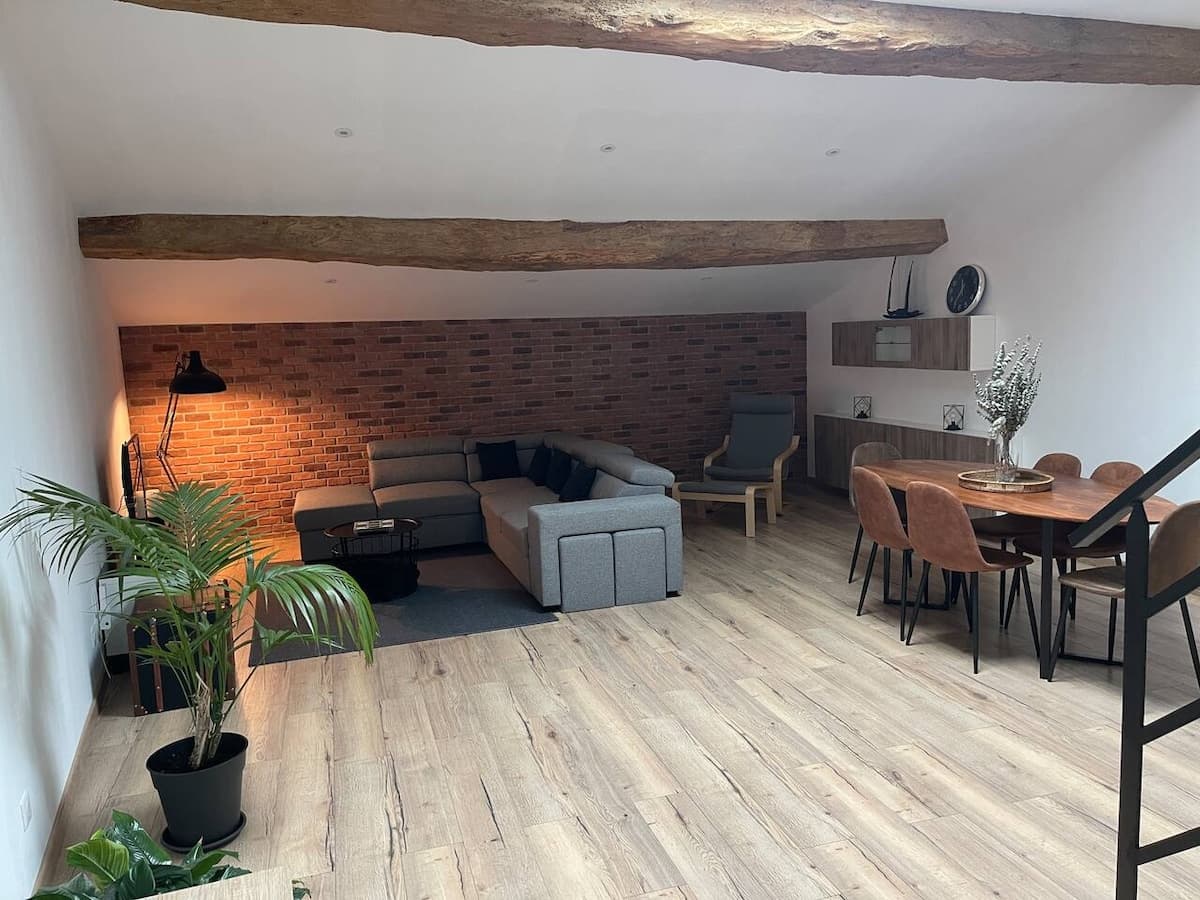
Sleep next door
The Industrial Lodge, an 85 m² loft for five in the hamlet of Dreuilhe. Booked direct, 10% less than on the platforms.
€63a nightwhen booking here€70 on the platforms
See also
Your host: Florian