
Saint-Félix-Lauragais: the hilltop village, its castle, hall and church
Saint-Félix-Lauragais is 11 minutes from the loft, on a ridge at 338 metres facing the Montagne Noire. People come for the square and its hall, the castle that opens in season, the collegiate church with its 18th-century organ, the Friday morning market and the paths that leave from the square. This page sticks to what the town hall, the tourist offices and the Ministry of Culture databases publish, checked on 29/10/2026.
A castelnau, not a bastide
Haute-Garonne Tourisme traces the village to a small Roman camp on the Trois Moulins hill, later a Visigothic castrum where digs turned up graves, bronze belt buckles and tear vials. Around the 10th century a lord's castle was built on the hill; in 1035 the lordship was held by Guillaume Jourdain. Simon de Montfort destroyed that castle during the Albigensian Crusade; the present one was rebuilt from the mid-13th century, and a new town was laid out beside it, founded in 1245 according to the Aux Sources du Canal du Midi tourist office.
The plan looks like a bastide's, a central square, a hall, a belfry, a grid of streets, ramparts, but the village was run by consuls under a lord who lived at its edge. Haute-Garonne Tourisme concludes that Saint-Félix is not a bastide but a castelnau. The commune now has 1,270 inhabitants over 51.88 km², at 338 metres, according to the town hall.
The council of 1167, with caution
Saint-Félix is often linked to a Cathar council of 1167. What we know rests on a single document, the so-called Charter of Niquinta: it presents itself as a copy made by Pierre Pollan in 1223 (or 1232 or 1233, depending on the variant) and describes an assembly held in 1167 at Saint-Félix under a dignitary from the East, Nicetas, who is said to have ordained six dissident bishops. The text is known only from its publication in 1660 in Guillaume Besse's history of the dukes, marquesses and counts of Narbonne.
Its authenticity is disputed. Antoine Dondaine defended it in 1946; the 1999 Nice conference around Monique Zerner, Jean-Louis Biget and Jacques Chiffoleau considered a modern or medieval forgery, and Biget sees it as a fake produced by Besse in the 17th century; the team of the Institut de recherche et d'histoire des textes, led by Jacques Dalarun, concluded the opposite after studying the document. So the careful wording is that a council may have been held here, without certainty. The present castle, rebuilt after 1245, is in any case later.
The castle
The Mérimée record describes a castle turned into a country palace in the 14th century by a brother of Pope John XXII. Its irregular quadrilateral mixes parts from the 13th to the 18th century: the north-west tower, the south-east corner keep, the chapel and the north wing predate the 14th century; the main east wing and the so-called Guards' Tower date from the 14th and 15th; the 16th and 18th centuries added and reworked the rest. It has been listed since 14 April 1994 and belongs to the commune. The remains of the ramparts, to the south-east, mark the 13th-century enclosure.
A visit takes in the courtyard, the terraces and the ground floor: the mosaic room, the keep's old kitchen, the Guards' Tower, the salons with Louis XVI stucco where exhibitions run from April, starting with the Cocagne festival, to the end of September. The castle opens during the hours of the tourist information office housed inside it; guided group visits are by reservation.
The hall and place Guillaume-de-Nogaret
The hall rests on sixteen octagonal timber posts set on stone bases, with moulded bases and capitals; a clock tower leans against its gable. The Mérimée database dates it to the 15th century and lists it by order of 9 November 1926; the town hall, for its part, places it at the village's origin, in the late 13th century. A statue of the Virgin was installed there in 1863, after a cholera epidemic. Half-timbered houses line the square.
The food market is held on Friday mornings on the square, with the producers under the hall, according to the tourist office; hours are not published. A Christmas market is announced for 29 November 2026.
The collegiate church and the Rabiny organ
A papal bull of 1318 created the town's chapter and building began around 1320. The apse vault, with liernes and tiercerons, dates from the late 14th century; at the end of the 16th a fire brought down the nave vault, replaced by timber panelling; the 17th century added a vaulted porch and side chapels. The church has been listed since 8 June 1920. Its tower-porch is 42 metres high and the choir was restored in 2018, according to the town hall.
The gallery organ was built between 1779 and 1781 by Joseph or Grégoire Rabiny, according to the Palissy database: the gallery and case have been listed since 5 July 1943, the instrument itself since 24 March 1967. The tourist office says a villager opens the church every day and that the organist gives recitals on Thursdays from 6 pm in summer; the town hall announces a concert in the church on Sunday 8 November 2026.
Déodat de Séverac's birthplace
The composer Déodat de Séverac (1873-1921) was born in a house on the square, bought in 1842 by his father, the painter Gilbert de Séverac. The Mérimée record dates it probably to the 18th century, with an older section, a studio skylight added in the 19th century and an Italian-style loggia along the whole upper floor; the rooms keep their original furniture. It has been listed since 17 September 1990 and remains private. A Déodat de Séverac festival honours him every year and an Espace Déodat de Séverac on place Guillaume-de-Nogaret presents his work; dates come from the tourist office.
Viewpoints, windmills and walks
The village offers, according to Haute-Garonne Tourisme, a view of the Pyrenees and the Montagne Noire. The tourist office places the orientation table on the Montfort tower, recommends sunset, and notes that the Pyrenees show on clear winter days; the castle terrace gives a second panorama. From rue des Nobles you see the Trois Moulins hill and its restored windmills; the commune has six mills, five of them in the village, two still awaiting restoration.
From the square, the Cimetière des Anglais loop runs 4.4 km in 1 h 20 with 147 metres of climb, yellow waymarks, past the orientation table, the castle, the hall, the collegiate church and the canonical house known as La Commanderie. The Fourches et Collines trail (7.9 km) and the Chemin d'En Bastide (5.2 km) also start in the village. Lac de Lenclas, 2.6 km away, bans swimming but allows fishing, with a playground, picnic area and a rail-bike.
The Cocagne festival, on Easter Sunday
Since 1972 the village has held a historical festival in costume on Easter Sunday: dances, medieval camps and combat, old trades, early music, street shows, more than thirty events according to the tourist office; the highlight is climbing the greased Cocagne pole on place Guillaume-de-Nogaret. The next edition shown on 29/10/2026 is Sunday 28 March 2027, the 51st, from 10 am to 10 pm, with a 9 € ticket booked online; check the date on the tourist office website before coming.
The name comes from the Pays de Cocagne, the region between Albi, Toulouse and Carcassonne made rich by woad in the late Middle Ages: the cocagne is the ball of crushed leaves that was the base of the blue dye. The story of woad has its own page.
Where to eat in the village
Three addresses appear on the tourist office listings checked on 29/10/2026; we do not rank them and are not partners with any. The other tables near the loft are on our restaurants page.
Frequently asked questions
What is there to see in Saint-Félix-Lauragais?
The square and its medieval hall, the castle open in season with its terrace, the collegiate church and its Rabiny organ of 1779-1781, Déodat de Séverac's birthplace seen from outside, and the orientation table on the Montfort tower. The village is 11 minutes from the loft.
Can you visit the castle of Saint-Félix?
Yes, in season, during the hours of the tourist information office housed in the castle: weekends and public holidays from 19 April 2026, then every day from June to September, according to the Aux Sources du Canal du Midi tourist office. Closed from October to March.
What day is Saint-Félix-Lauragais market?
Friday mornings on place Guillaume-de-Nogaret, with the producers under the hall, according to the tourist office. Revel's market is on Saturday mornings.
Was there really a Cathar council in Saint-Félix in 1167?
Possibly, not certainly. The assembly is known only from a document published in 1660, the Charter of Niquinta, whose authenticity divides historians: a 17th-century forgery for Jean-Louis Biget, a genuine document for Jacques Dalarun's team.
When is the Cocagne festival?
On Easter Sunday, since 1972. The next edition shown by the tourist office on 29/10/2026 is 28 March 2027; check the date on its website.
Sleep next door
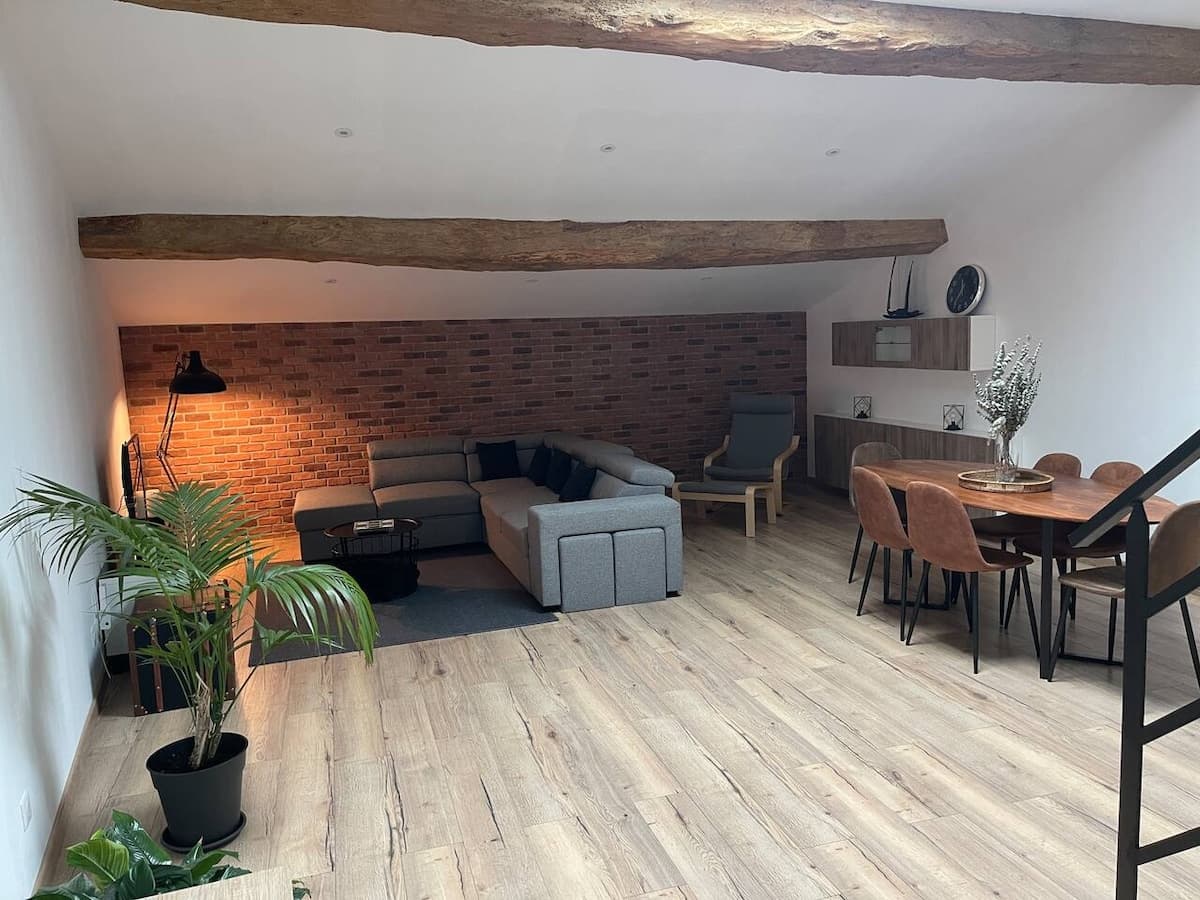
The Industrial Lodge, an 85 m² loft for five in the hamlet of Dreuilhe. Booked direct, 10% less than on the platforms.
€63a nightwhen booking here€70 on the platforms
See also
Your host: Florian